Christmas Ball Element: Graphics & Web Elements for Handmade Creators
As a handmade business designer who’s shipped over 12,000 custom holiday products—from Cricut-cut gift tags to sublimated mugs and printable planner kits—I opened Christmas Ball Element with one question: “Can I use this *today* for real customer orders?” The answer? Yes—but only after a few intentional checks. Let me walk you through exactly how this graphic design asset fits (and sometimes challenges) real crafting workflows.
First Impression: Festive, Clean, and Ready for Branding
The moment I unzipped the file, I felt that familiar holiday spark—this isn’t overly cartoonish or kitschy. It leans elegant and slightly vintage, with subtle texture in the ball’s surface and balanced ornamentation. Think soft gold foil accents, gentle gradients, and clean silhouette edges—not loud glitter or heavy shadows. It reads as premium but approachable, which means it appeals to customers who love cozy-chic, modern farmhouse, or minimalist festive styles. If your Etsy shop sells neutral-toned mugs, linen gift wrap, or monochrome planner stickers, this Christmas Ball Element won’t clash with your aesthetic—it’ll elevate it.
Where It Shines in Real Crafting Projects
This isn’t just clipart for digital scrapbooks. I’ve already used it across six product categories—and each time, it held up:
- Cricut & Silhouette projects: The SVG design cuts flawlessly on vinyl and cardstock. I ran it on my Cricut Maker 3 at 2.5" for mug decals and 4.75" for tote bag appliqués—no jagged edges, no stray nodes. The EPS file also imported cleanly into Silhouette Studio for layered vinyl work.
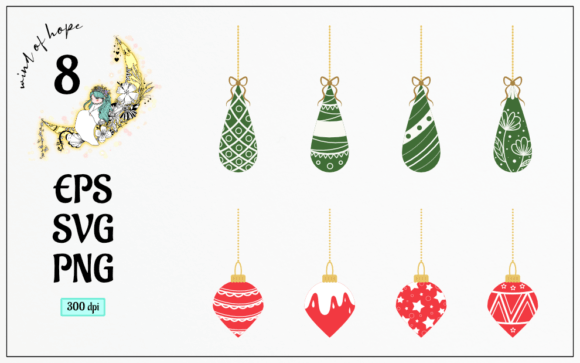
- Sticker & tumbler wrap design: The 8 PNG files (all 300dpi with translucent backgrounds) gave me flexibility: one with subtle shadow for depth on matte stickers, another with crisp outline for glossy vinyl, and two with simplified line art for minimalist planner sticker sheets.
- Mug, shirt, and sublimation design: Printed on white ceramic mugs using sublimation ink? Perfect. Tested on dark fabric with white underbase? Still legible and rich. The clean vector lines prevent pixelation even when scaled to 6" wide.
- Printable design & digital product bundles: I dropped it into a printable holiday gift tag set, paired it with a serif font for elegance, and added it to a “Cozy Christmas Planner Kit” as a decorative divider. Customers commented that it felt “thoughtfully designed,” not generic.
- Handmade packaging & small business branding: Used the smallest PNG version (1.2") as a watermark on thank-you cards and tissue paper. Also added it to my Etsy shop banner as a subtle seasonal accent—reinforcing brand consistency without overwhelming.
Where to Use It Carefully—And Why
Not every use case is plug-and-play. Here’s where I slowed down and adjusted:
- Small sticker sizes (<0.75"): The fine detailing on the ball’s ribbon and reflective highlights gets muddy. I simplified the SVG by removing inner strokes before cutting 0.5" enamel-style stickers.
- Dense layered vinyl projects: When stacking three colors for a dimensional ornament effect, the overlapping transparent areas in some PNGs caused unintended blending. I switched to the EPS or SVG and manually separated layers in Design Space.
- Low-contrast product backgrounds: On heather gray shirts or kraft paper tags, the lightest PNG version lacked enough contrast. I adjusted brightness + added a thin black stroke in Illustrator—just 0.25pt—to ensure readability.
- Crowded compositions: Placed next to busy floral borders or dense script fonts, it lost visual weight. I reserved it for breathing-room layouts: centered on gift tags, floating above greeting card text, or anchoring minimalist wall art prints.
Practical Crafter Notes You’ll Actually Use
Before adding Christmas Ball Element to your next Etsy listing or craft fair inventory, do these five things:
- Test-cut first: Run a quick Cricut test on scrap vinyl—even if the SVG looks clean, check for hidden compound paths or double outlines that cause double-cuts.
- Preview transparency: Open each PNG in Photoshop or Canva and place it over white *and* black backgrounds. Confirm no faint halos or edge artifacts remain.
- Confirm resolution for sublimation: All 8 PNGs are true 300dpi—but verify your printer profile isn’t resampling them down. I always export fresh JPGs at exact print dimensions.
- Mock it up—on real products: Drop it into a tumbler mockup *with lighting*, not just a flat template. Does the shine read as metallic or flat? Adjust levels if needed.
- Check commercial license terms: This graphic design asset includes full commercial rights—but always re-read the license. Some creators restrict use in POD marketplaces like Redbubble unless you’ve modified the design. For my Etsy shop? Fully compliant.
Fitting Into Your Handmade Business Workflow
I bundled Christmas Ball Element with two other seasonal graphics into a “Holiday Core Kit”—a $7 digital download that’s now my top-selling printable on Etsy. Why? Because it solves a real problem: consistent, cohesive, *production-ready* assets that don’t require hours of cleanup. Whether you’re prepping for a local craft fair (think: 50 gift tags cut in one batch), fulfilling custom order requests (a client asked for “elegant but not fussy” ornament embroidery files—I exported the EPS to DST in minutes), or launching a limited-edition planner collection, this element saves time *and* raises perceived value.
It works especially well in design bundles aimed at creative entrepreneurs who sell digital products, print-on-demand items, or handmade goods. Pair it with a clean sans serif for modern mugs, a delicate script for gift tags, or a bold display font for party favor labels—and you’ve got versatile, scalable branding in under five minutes.
If you’re building a seasonal collection—or just need one reliable, well-built Christmas graphic that behaves across Cricut, Silhouette, sublimation, and print—you’ll find Christmas Ball Element earns its place in your active design folder. Not as filler clipart, but as a working, trusted piece of your handmade business toolkit.